A hopper, an auger and a fan — and three parts that wear · review
UMBRELLA P18 Hydro, 18 kW review
A water-carrying appliance that publishes both halves of its output, its efficiency, its hopper and its run time — and a subsidy claim with its own disclaimer.
The bottom line The one to shortlist if the appliance has to be left alone: a 40 kg hopper, the largest here, against a run of 11 to 18 hours, with 12.5 kW of water-side output and 90.8 % efficiency published. Two cautions — the total output is printed as 18 / 10 kW with no explanation, and the 300 m³ coverage figure names no insulation assumption.
What the maker’s page says
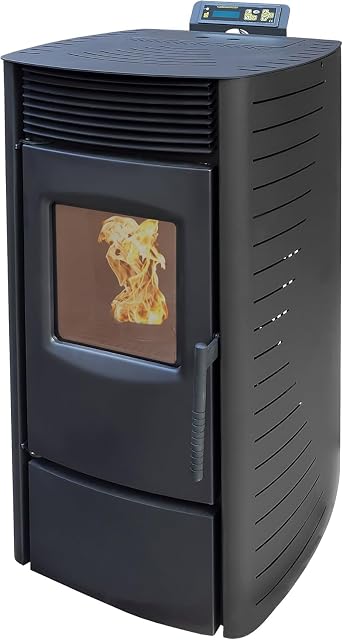
A black water-carrying hydro pellet appliance stated at 18/10 kW total output
with up to 12.5 kW on the water side, efficiency 90.8 %, energy label A+, a
40 kg pellet hopper and an automatic burn duration of up to 18 hours with a
minimum of 11. Auto and manual operation, ECO1 and ECO2 modes, a timer, power
levels and a weekly programme; stated as Wi-Fi ready. A vacuum switch monitoring
the flue path and overheat protection. Stated coverage up to 300 m³. The listing
states that a national subsidy may be available, with its own note that approval
and conditions are assessed individually and can change.
The figure a water-carrying appliance is bought on
12.5 kW on the water side.
This is what separates this appliance from the air-only half of the shelf, and
it is the number a heating system is specified around. One of the three
water-carrying appliances in this family publishes it; the other two do not.
The total is printed as a pair — 18/10 kW — without the listing saying which is
which. On this kind of appliance a pair like that usually separates the total
from the room-side share, and the maker has not said so, so this page prints the
pair as published and does not construct the distinction.
The largest hopper here, with a real range
40 kg, and a burn duration stated as up to 18 hours with a minimum of 11.
That is the longest attended interval published in this family by a substantial
margin, and it is published as a range rather than as a single best case — which
is the more useful form.
Both figures are the maker’s at its own conditions. An appliance run at a higher
setting empties a hopper faster, and no listing figure describes your evening.
The subsidy line, and why it is reported as it is
The listing states that a national subsidy may be available, and attaches its
own note: approval and conditions are assessed individually and can change.
That caveat is the maker’s, not ours, and it is the correct form. This page
reports the claim and the caveat together and does nothing else with it —
whether any programme applies to you is a question for the body administering
it, and it is exactly the kind of statement that ages badly in a product
listing.
The 300 m³ line
Stated flatly, with no insulation assumption named.
One appliance in this family attaches the condition to its coverage figure and
this is not it. A heatable volume is arithmetic against an assumed building; the
page prints the figure as the maker’s and produces none of its own.
Where it is sold
Availability
As this page was put together, the price ran from 3599 € to 4099 € at the German, French, Italian and Spanish Amazon stores.
Asked, the American and British Amazon stores returned not a single line; the buy button there opens a search rather than an empty page.
Keepa reading from the day this page was last updated; stock and prices change without warning.
Prices quoted in this text were read on 22 September 2026. The live price is at the top of the page.
The declared numbers, and where they stop
Strengths
Publishes the water-side output as well as the total, which is what a water-carrying appliance is specified on
The largest hopper in this family at 40 kg, with a run time range rather than a single figure
Efficiency published to a decimal place
The subsidy claim carries the maker’s own caveat rather than being stated flatly
Compromises
The total output is printed as two numbers with no explanation of which is which
A 300 m³ coverage figure with no insulation assumption named
No flue outlet diameter and no noise level
Specifications
Nominal output
18 / 10 kW, as published · up to 12.5 kW
Reduced output
The maker does not state it.
Efficiency
90.8 %
Hopper capacity
40 kg
Noise level
The maker does not state it.
Flue gas temperature
The maker does not state it.
Flue outlet diameter
Not published
Stated coverage
up to 300 m³, as published
Energy label
A+ · Stated as possibly eligible, with the maker’s own conditions attached
Control
up to 18 h automatic, min. 11 h · Auto and manual, ECO1/ECO2, timer, power levels, weekly programme · Stated as Wi-Fi ready · Vacuum switch monitoring the flue path; overheat protection
Dimensions
The maker does not state it.
Weight
The maker does not state it.
Amazon reference
B0FPMWXCWB (one reference across 4 Amazon marketplaces)
EAN
4068578025197
Questions this one prompts
What does “18/10 kW” mean?
The listing prints both figures without saying which is which, and this page does not guess. On water-carrying appliances a pair like that usually separates a total from a room-side share, but the maker has not said so and inventing the distinction is exactly what this site avoids.
Why is the 40 kg hopper significant?
Because a hopper and a run time together decide how often the appliance is attended to, and 40 kg with a stated 11 to 18 hours is the longest interval published in this family. Both figures are the maker’s at its own conditions.
Should I count on the subsidy?
The maker itself attaches a caveat saying approval and conditions are assessed case by case and can change. This page reports the claim and its caveat together, which is how the maker wrote it, and takes it no further.
Who this one is for
A heating circuit that needs a stated water-side output and a hopper big enough to be left alone