What the maker’s page says
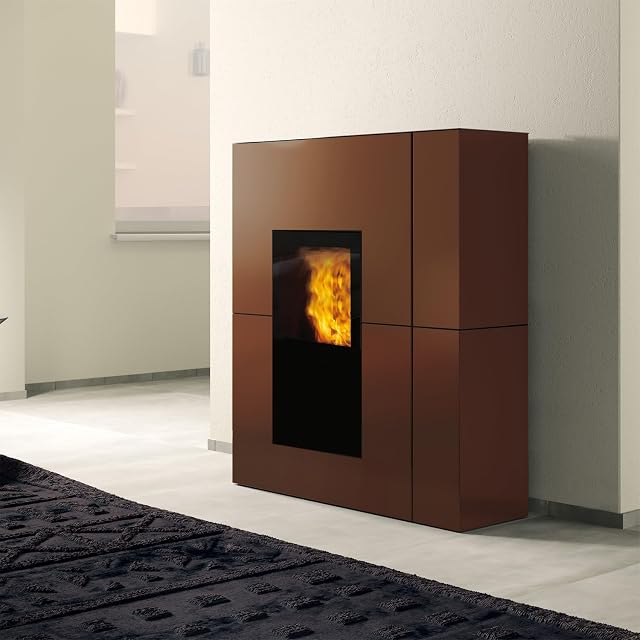
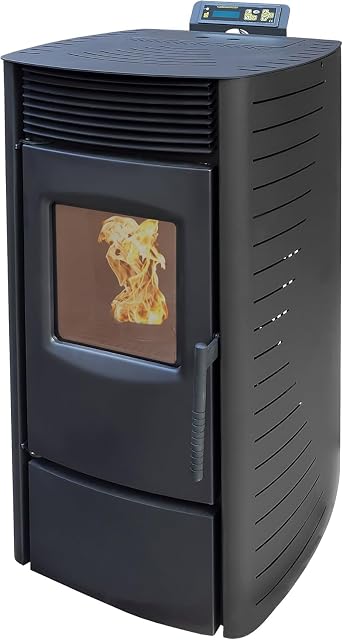
A white pellet stove of 93 × 51 × 48 cm and 80 kg empty, with a maximum useful
output of 9.9 kW and a minimum of 4.3 kW, efficiency 91 %, combustion efficiency
published as min. 94 % and max. 90 %, pellet consumption from 0.94 kg/h, a 15 kg
hopper, a maximum run time of 20 hours, an 80 mm flue outlet, electrical
consumption of 150–360 W, a noise level of 34 dB and daily and weekly
programming. The listing states heating up to 80 m², five speeds and power
levels, and a four-star certification under emission and performance
requirements.
The one listing on this shelf that publishes what owners complain about
34 dB.
Noise is the property owners of pellet appliances raise most and the figure
makers publish least — eight of the nine appliances in this family give nothing
at all. This one gives a number.
It is the maker’s own, without a stated measurement condition, and this page
prints it as such. What it is not is a measurement this site made, and what it
does not describe is the auger, which is intermittent and has a different
character from the fan.
Both ends of the range, which is the point of a pellet appliance
9.9 kW at the top, 4.3 kW at the bottom.
A log stove publishes one figure because a test can hold it at one operating
point. A pellet appliance meters its own fuel, so its standard establishes
figures at nominal and at reduced output — and a compliant data sheet publishes
both.
That is why a pellet appliance tolerates generous sizing in a way a log stove
does not: its low setting is a tested condition rather than a throttled one.
Six of the nine appliances in this family publish only one end. This one
publishes both.
Two contradictions worth reading
The title says 10 kW; the specification says a maximum of 9.9 kW. Both are the
seller’s figures, and this page prints the specification line because it carries
the range.
The combustion efficiency line reads min. 94 % and max. 90 %, which is inverted
as printed. It is reproduced here exactly as published rather than silently
corrected, because correcting a maker’s figure is how a page starts carrying
numbers nobody wrote.
The filling interval, derivable for once
A 15 kg hopper, a stated maximum run time of 20 hours, and a minimum consumption
of 0.94 kg/h.
Those three together are what decides how often the appliance is filled, and
this is the only listing in the family that publishes all three. They are the
maker’s figures at the maker’s stated conditions; a real evening at a higher
setting is a shorter interval.
Where it is sold
Availability
As this page was put together, the price ran from 919 € to 1149 € at the German, French, Italian and Spanish Amazon stores.
The reference appears in the British Amazon catalogue, with no seller behind it.
Asked, the American Amazon store returned not a single line; the buy button there opens a search rather than an empty page.
Keepa reading from the day this page was last updated; stock and prices change without warning.
Prices quoted in this text were read on 22 September 2026. The live price is at the top of the page.